Compare coherence-guided and learned attention on clean recorded data and controlled corruptions such as blur, dropout, delay, drift, and clipping.
Research deep dive
Adaptive Sensor Attention
Can a model change how strongly it relies on each available sense from moment to moment?
UNDER INVESTIGATIONLast updated · August 23, 2026
01 · Simple explanation
The question in plain language.
All sensors stay available. What changes is the influence each sensor representation has on the next prediction or decision.
02 · Visual walkthrough
Follow the mechanism.
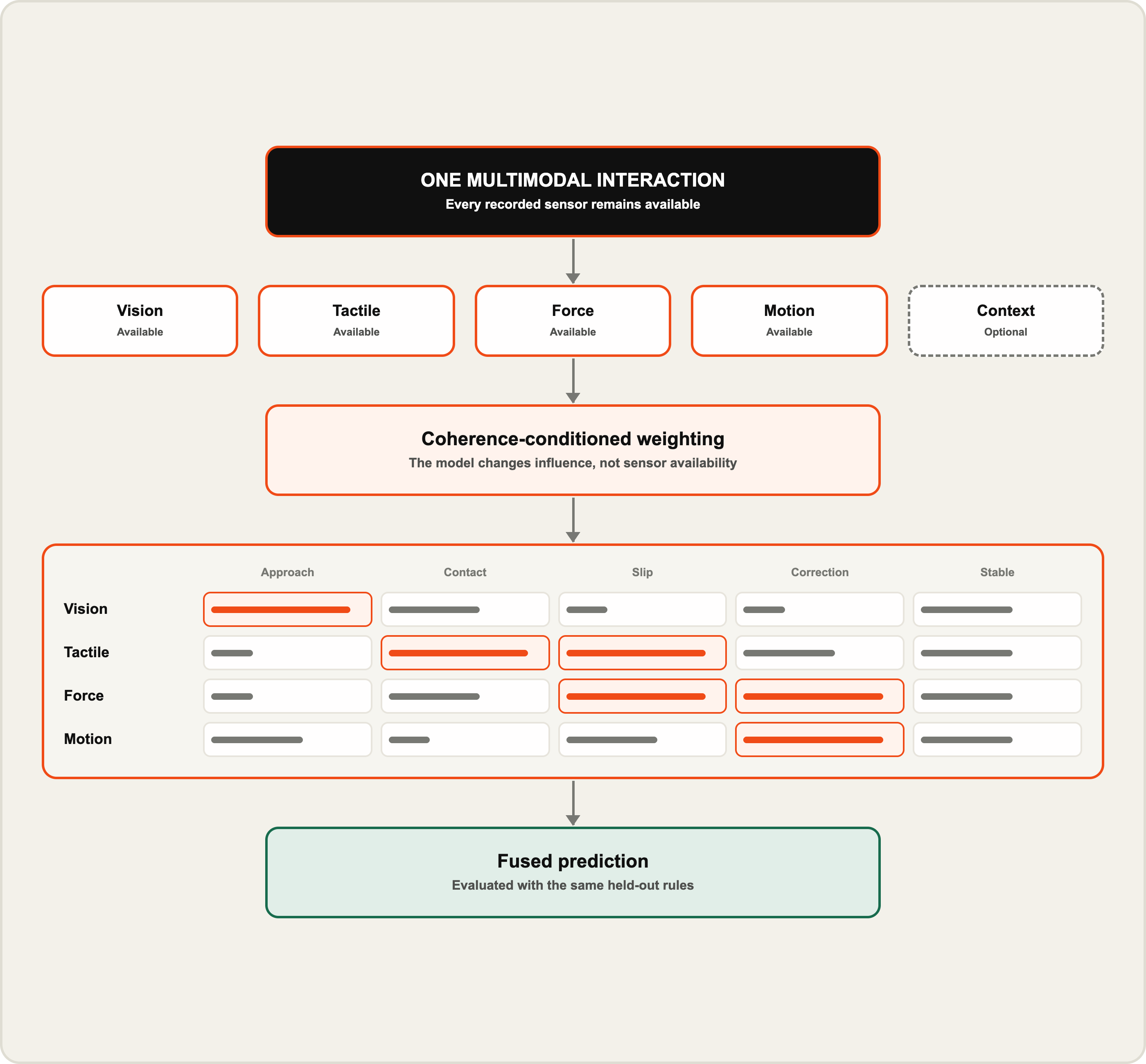
A glass grasp illustrates shifting influence. Sensors are not switched off; their relative contribution changes with the interaction.
EXPLAINER CLIP8 TO 12 SEC
Reserved for an approved motion explanation. The walkthrough and caption above provide the complete text equivalent.
03 · Full narrative
What the idea means and what it does not.
During a reach, vision may carry the most useful information. As the hand approaches a glass, distance and motion can matter more. At touch and grip, force and tactile data become central; during slip, vibration may rise sharply.
The governing Phase One Objective 2 is an offline recorded-data fusion experiment. A later execution-oriented hypothesis asks whether a trained model can shift attention during a live task without retraining.
These maturity levels remain separate so an intuitive live-execution picture is not mistaken for a completed robot result.
04 · Technical detail
A falsifiable path forward.
Fixed fusion, shuffled gates, single-modality models, and a matched learned-attention baseline.
Prediction quality, corruption robustness, calibration, modality-weight stability, and held-out generalization.
Synchronized multimodal records, known corruption protocols, and interpretable modality-weight logs.