Run matched offline-learning comparisons using identical models, budgets, and seeds while changing only the curated data condition.
Research deep dive
Phase One evidence program
Can coherence make recorded multimodal manipulation data more useful for offline learning, and does the effect survive beyond the first model?
DESIGNED AND DOCUMENTEDLast updated · August 23, 2026
01 · Simple explanation
The question in plain language.
Phase One is the current evidence spine: compatibility first, then curation, measurement, and required portability before a core claim can be supported.
02 · Visual walkthrough
Follow the mechanism.
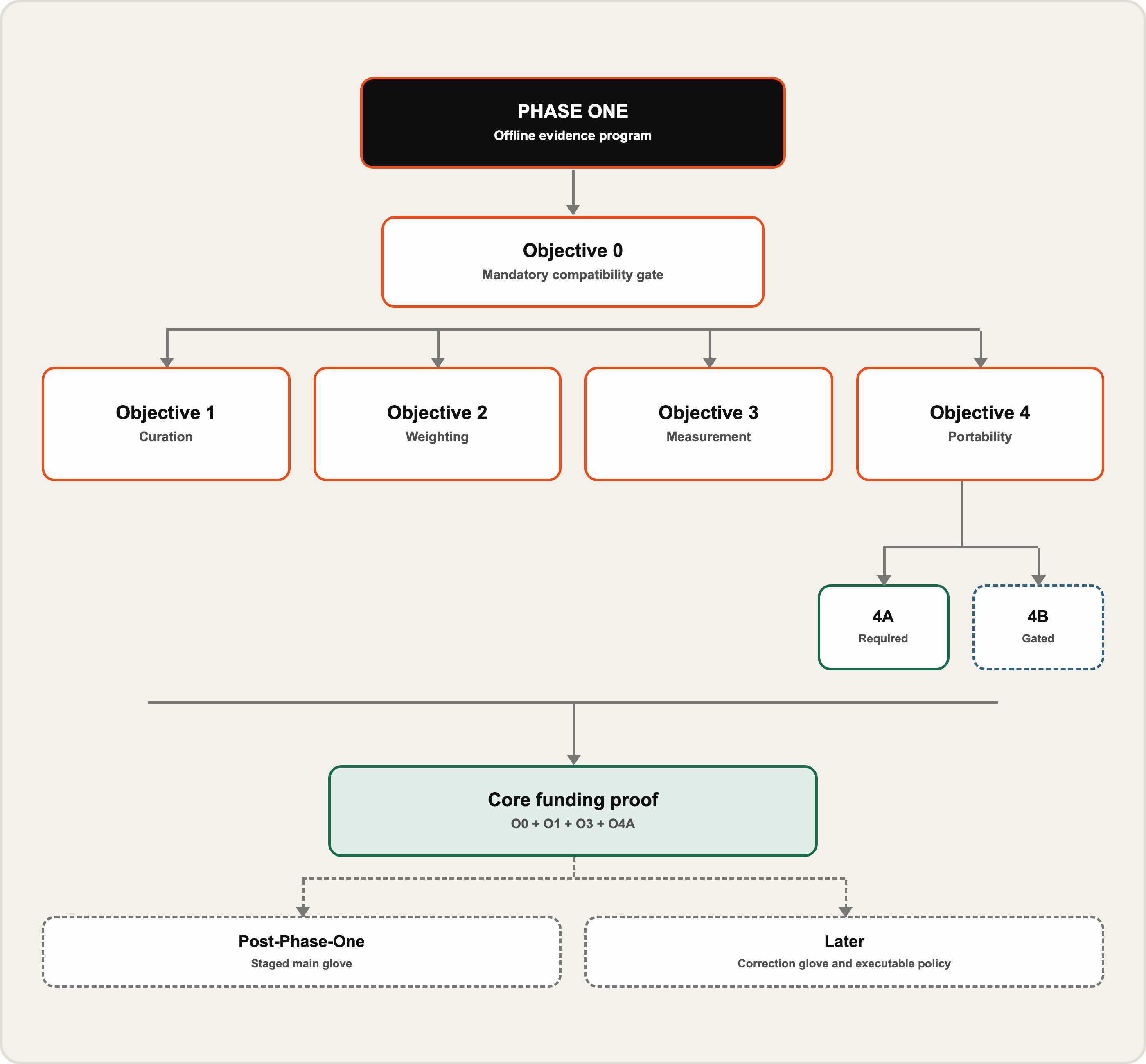
O0, O1, O3, and O4A form the core proof. O2 can strengthen the case, while O4B remains separately gated.
EXPLAINER CLIP8 TO 12 SEC
Reserved for an approved motion explanation. The walkthrough and caption above provide the complete text equivalent.
03 · Full narrative
What the idea means and what it does not.
The program begins by asking whether an experiment can honestly be run with the available data, permissions, labels, timing, actions, outcomes, and environment. Only compatible protocols move forward.
Curation then tests whether some complete demonstrations, windows, or trajectory segments have greater learning value. The measurement layer defines admissible metrics, matched comparisons, provenance, and stopping rules before results are interpreted.
The core selection effect must survive in a second compatible architecture. An OpenVLA path proceeds only if observations, actions, embodiment, tactile inputs, evaluation, licensing, and compute all pass a separate compatibility gate.
04 · Technical detail
A falsifiable path forward.
Unfiltered data, random matched subsets, heuristic filters, and a second compatible architecture for portability.
Task-level outcome, data efficiency, robustness, calibration, uncertainty, and reproducibility records defined before confirmation.
Dataset permissions and schema, aligned timestamps, actions and outcomes, compatible policy code, and sealed confirmation data.