Allow one bounded topology, grouping, or weighting proposal per cycle and compare accepted structures with a fixed architecture.
Research deep dive
Agent structure discovery
Can bounded computational agents discover how learning information should be connected, grouped, weighted, stabilized, and extended?
RESEARCH DIRECTIONLast updated · August 23, 2026
01 · Simple explanation
The question in plain language.
Agents are an experimental mechanism for organization, not branding. Every proposed structural change must pass a predefined held-out test or be reverted.
02 · Visual walkthrough
Follow the mechanism.
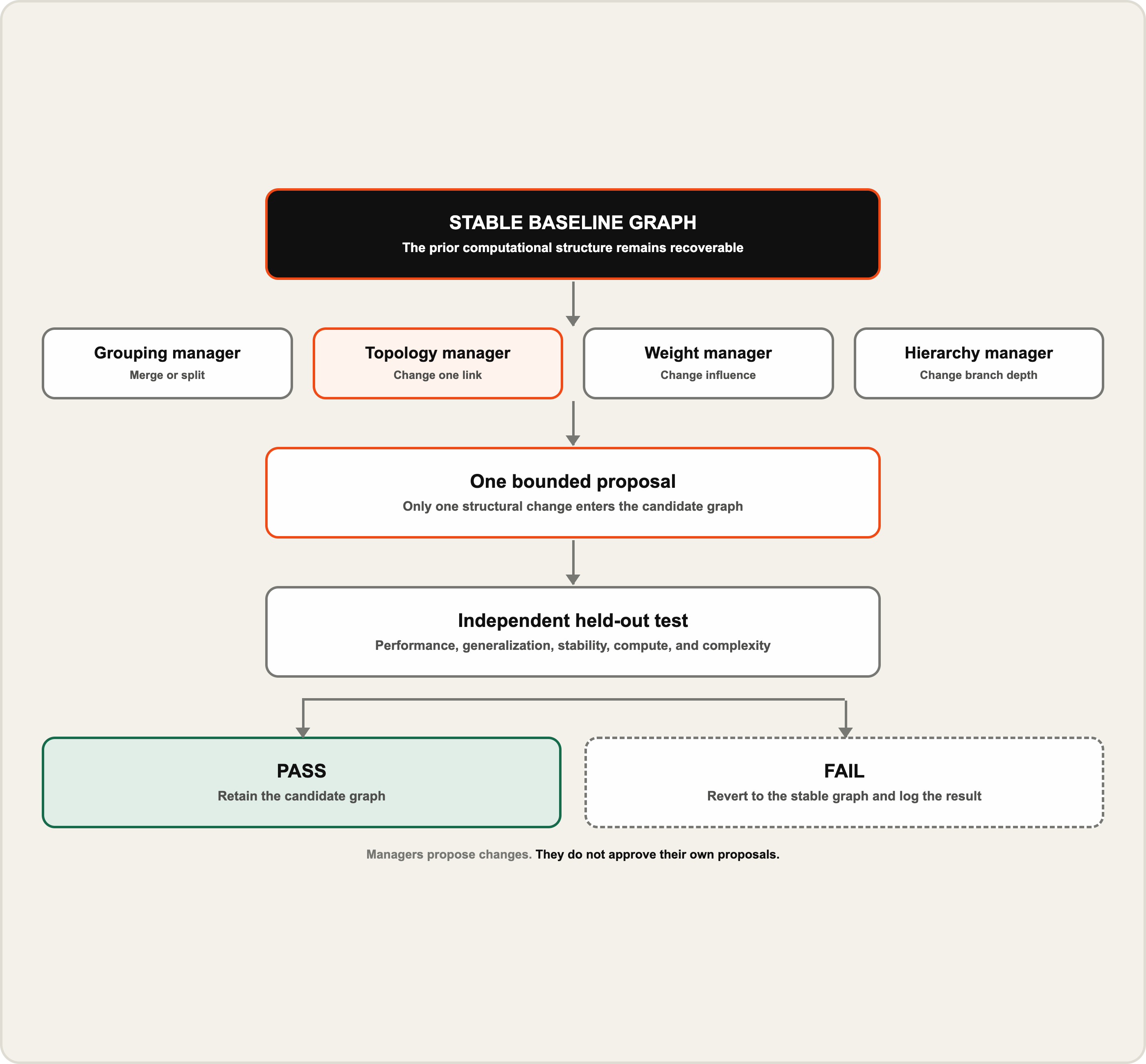
The loop begins from a fixed baseline and permits one bounded structural proposal at a time.
EXPLAINER CLIP8 TO 12 SEC
Reserved for an approved motion explanation. The walkthrough and caption above provide the complete text equivalent.
03 · Full narrative
What the idea means and what it does not.
Agents as nodes receive information, transform it, and produce outputs. Agents as connectors decide which units exchange information. Structure managers propose splits, merges, link changes, hierarchy changes, or weighting changes.
The system begins from a fixed baseline, permits one bounded proposal, and evaluates it under the same held-out rules. Failures are reverted and logged.
A later neuroplasticity-inspired variant may alternate plastic search with consolidation into a stable layer. That is inspiration for a staged learning pattern, not a claim of biological equivalence.
04 · Technical detail
A falsifiable path forward.
Strong fixed architecture, random proposals, standard architecture search, and equal-compute controls.
Held-out performance, stability, search cost, complexity, recovery from failed proposals, and reproducibility.
Bounded proposal space, explicit guardrails, rollback logs, and matched compute budgets.