Incrementally compare small sets of successful histories and evaluate proposed relationships on held-out variations.
Research deep dive
Learning from a few successful attempts
What reusable relationships can be learned from the unavoidable variation among only a few successes?
PROPOSED HYPOTHESISLast updated · August 23, 2026
01 · Simple explanation
The question in plain language.
Each successful attempt differs in path, force, timing, contact, or correction. The hypothesis is that comparing those differences can reveal stable structure early.
02 · Visual walkthrough
Follow the mechanism.
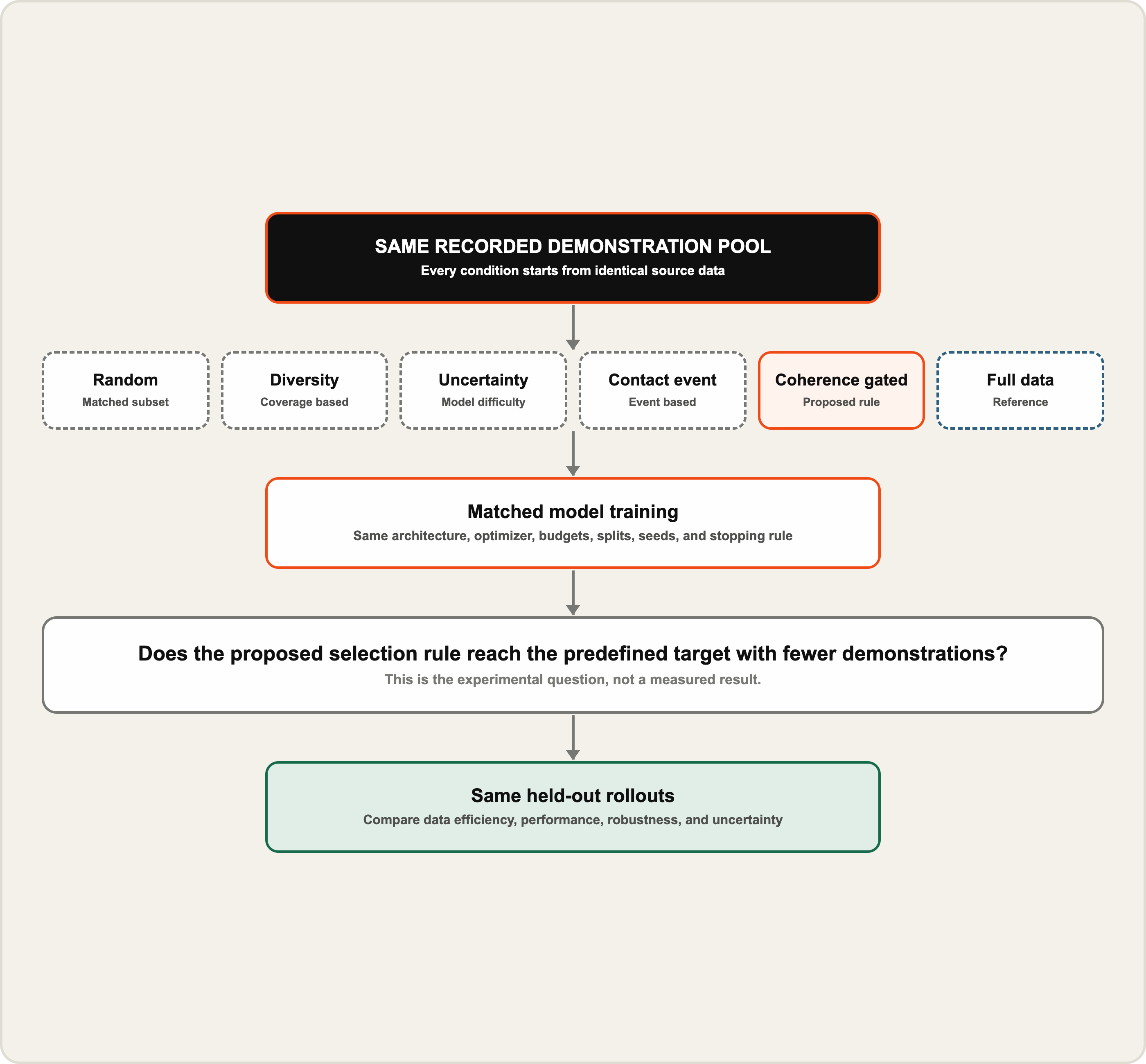
The mechanism uses unavoidable variation between successful histories; it is not a proposal for deliberate random exploration.
EXPLAINER CLIP8 TO 12 SEC
Reserved for an approved motion explanation. The walkthrough and caption above provide the complete text equivalent.
03 · Full narrative
What the idea means and what it does not.
A first success becomes a reference. The next success is never identical: path, timing, force, correction, or contact may vary. Their comparison asks what stayed stable and whether the changed relationship improved or degraded the outcome.
Natural task milestones such as grasp acquired, alignment achieved, insertion begun, and object stabilized may provide local anchors for credit instead of relying only on final success.
The experiment must still determine whether any inferred relationship transfers and outperforms strong few-shot or sequence-learning baselines.
04 · Technical detail
A falsifiable path forward.
Standard fine-tuning, behavior cloning, nearest-neighbor retrieval, and matched few-shot sequence models.
Success under new conditions, attempts to competence, calibration, and stability of inferred relationships.
Comparable success definitions, milestone annotations or discovery, and held-out variation that prevents memorization.