Compare conventional, explicit fixed, and adaptive hierarchies under the same data, compute, and evaluation rules.
Research deep dive
Hierarchical coherence
Does explicit and recursively refined comparison structure add value beyond hierarchy learned implicitly by a strong model?
RESEARCH EXTENSIONLast updated · August 23, 2026
01 · Simple explanation
The question in plain language.
Begin with a broad group, measure meaningful deviation, create narrower groups, and stop each branch when another level no longer adds measurable value.
02 · Visual walkthrough
Follow the mechanism.
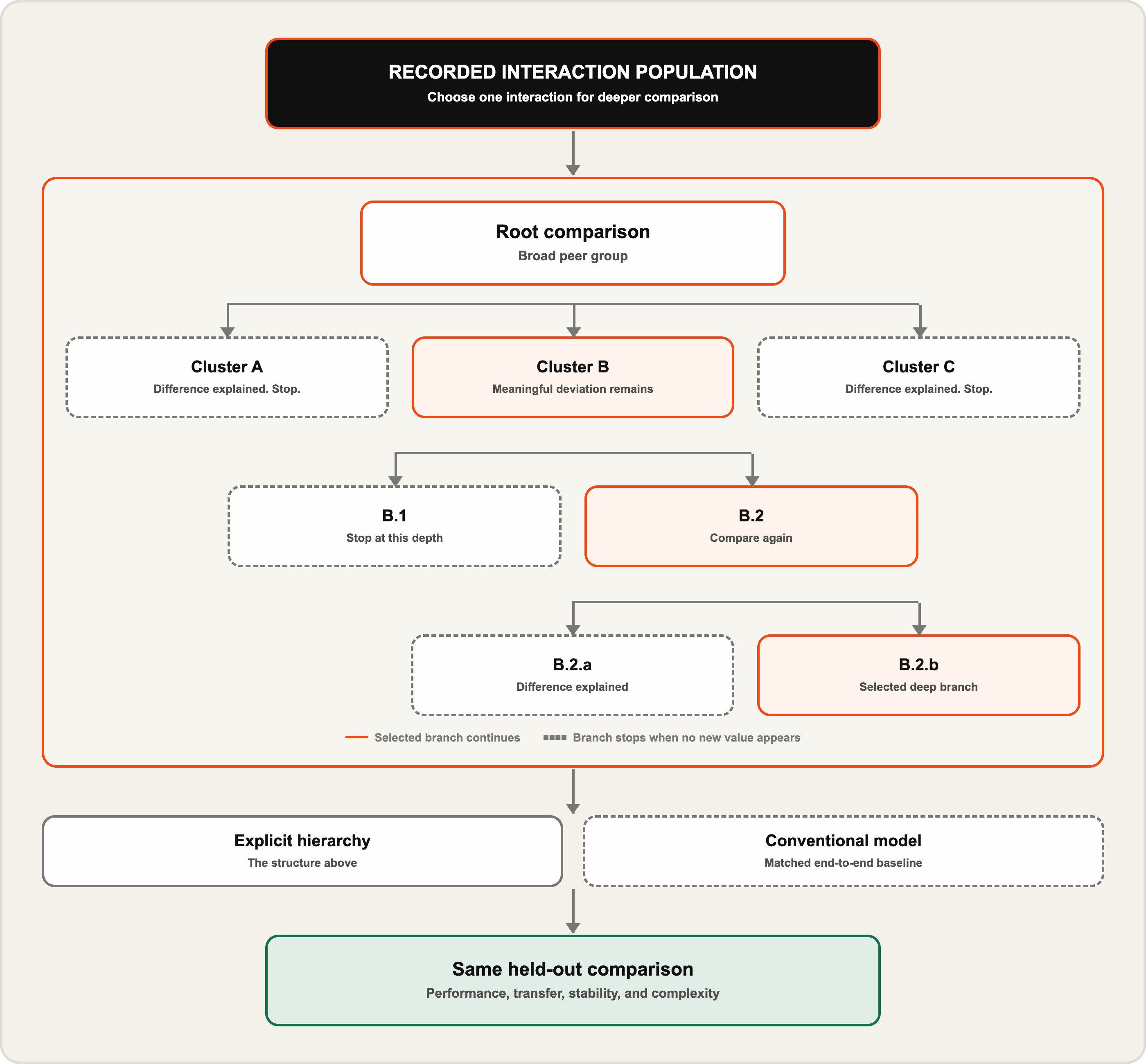
Different branches may stop at different depths. The hierarchy is an experimental comparison structure, not a fixed five-layer claim.
EXPLAINER CLIP8 TO 12 SEC
Reserved for an approved motion explanation. The walkthrough and caption above provide the complete text equivalent.
03 · Full narrative
What the idea means and what it does not.
A fixed variant defines the hierarchy and uses it for scoring. An adaptive variant allows groupings, branch depth, and possibly weights to change as evidence accumulates.
Both must compete against a strong conventional model that may learn sufficient hierarchical structure internally. If the conventional model wins, explicit hierarchy has not earned its added complexity.
Depth is evidence-driven. A branch continues only while the next level reveals measurable new information under held-out testing.
04 · Technical detail
A falsifiable path forward.
Strong end-to-end model, fixed explicit structure, adaptive structure, and shuffled grouping controls.
Held-out performance, transfer, data efficiency, complexity cost, branch stability, and calibration.
A defensible comparison distance, bounded update rules, held-out tasks, and complexity penalties.