Compare raw sequence training with fixed-tolerance packets, learned boundaries, and clustered reusable units.
Research deep dive
Movement vocabulary and packets
Can small pieces of physical interaction become reusable units that transfer across objects and tasks?
WORKING REPRESENTATION HYPOTHESISLast updated · August 23, 2026
01 · Simple explanation
The question in plain language.
A working packet is a stable interval separated by a meaningful change. The ordered trajectory may organize packets into a larger pattern, but a packet is not automatically a word.
02 · Visual walkthrough
Follow the mechanism.
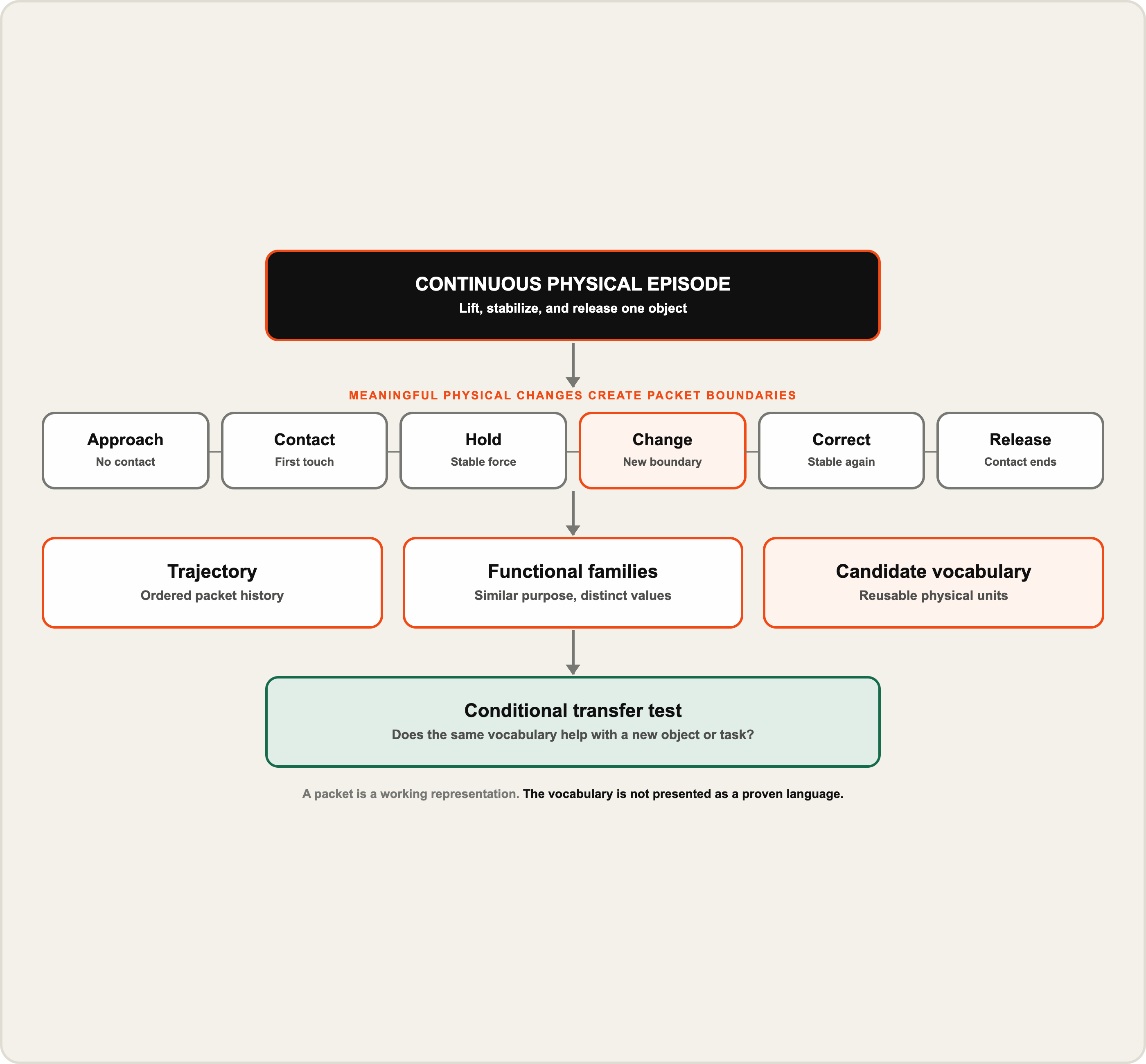
Numerically different packets can belong to the same functional family while preserving their differences and weights.
EXPLAINER CLIP8 TO 12 SEC
Reserved for an approved motion explanation. The walkthrough and caption above provide the complete text equivalent.
03 · Full narrative
What the idea means and what it does not.
A packet is a continuous interval during which a measured physical quantity stays effectively constant. Because real sensors are noisy, constant must be defined by a tolerance rather than literal equality.
When force changes meaningfully, a new packet begins. The trajectory is the ordered path through packets and other interaction information, and it helps organize small units into a reusable pattern.
Holding a cup at 4 N and 5 N may serve the same function while remaining distinct values inside a cluster. The research question is whether explicit or discovered units improve transfer beyond raw demonstrations.
04 · Technical detail
A falsifiable path forward.
Raw trajectories, uniform time windows, hand-set packets, and automatically discovered packets.
Transfer, data efficiency, boundary stability, interpretability, compression cost, and held-out task performance.
Synchronized signals, noise models, tolerance definitions, and transfer criteria defined before evaluation.