Construct matched offline datasets in which the only controlled variable is the presence of irreversible contact transitions. Train identical architectures on fully reversible trajectories, trajectories containing irreversible events with the failed first half discarded, and trajectories that retain the irreversible first half and require mid-execution recovery. After the irreversible event, inject localized compliance changes and asymmetric latency perturbations.
Research deep dive
Recovery under irreversible contact
Can a learning system recover useful structure from contact events that permanently change the state of the world, or does it only succeed when the physical trajectory remains reversible?
RESEARCH EXTENSIONLast updated · August 25, 2026
01 · Simple explanation
The question in plain language.
Most recorded demonstrations and simulated rollouts treat physical interaction as something that can be rewound or replayed. Real contact is often irreversible: a surface deforms, an object shifts into a new stable pose, a force threshold is crossed, and the configuration space changes.
This direction asks whether the learning architecture can still extract transferable recovery operators when the available data contains these permanent transitions, and whether the system can correct mid-execution once the irreversible event has already occurred.
02 · Visual walkthrough
Follow the mechanism.
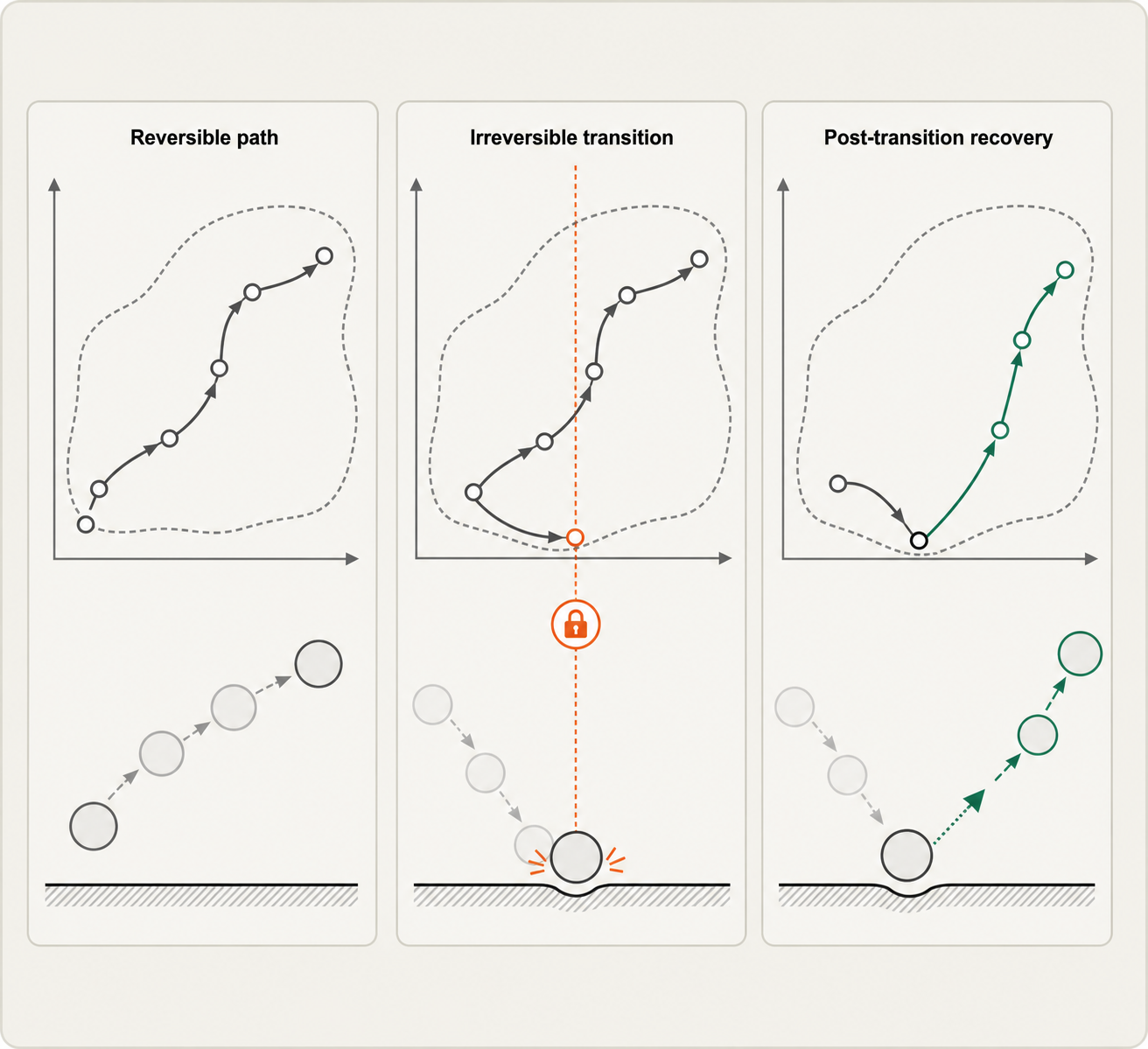
The same interaction is shown as a reversible baseline, an irreversible state change, and a post-transition recovery path that cannot return to the original configuration.
EXPLAINER CLIP8 TO 12 SEC
Reserved for an approved motion explanation. The walkthrough and caption above provide the complete text equivalent.
03 · Full narrative
What the idea means and what it does not.
Current predictive world models and end-to-end policies are typically trained and evaluated on trajectories that remain statistically reversible or that can be reset in simulation. Real skilled physical work frequently contains irreversible steps: plastic deformation, object nesting, adhesive contact, or irreversible force thresholds.
The experiment isolates those moments. It retains the failed or altered first half of the trajectory, which contains the irreversible event, and tests whether the second half still yields reusable recovery structure. It also injects controlled, localized compliance and delay perturbations after the irreversible transition to distinguish true online correction from scripted recovery that only works while the original state space remains open.
This is not a claim that irreversible events are the only hard cases. It is a diagnostic that many current evaluation regimes avoid. The goal is to measure whether coherence-gated selection and layered evaluation still surface useful structure once the physical path can no longer be replayed.
04 · Technical detail
A falsifiable path forward.
Unfiltered multimodal data, reversible-only subsets, conventional success-filtered data, and a second compatible architecture for portability.
Recovery success rate after irreversible transition, sample efficiency of the recovered operator, robustness under post-transition compliance and delay perturbations, and whether the selected structure transfers to held-out objects and force regimes.
Time-aligned force, tactile, and proprioceptive streams with clear irreversibility markers; sealed confirmation splits; matched compute and seed budgets; and the ability to inject controlled compliance and latency perturbations without breaking the sensor schema.